
When choosing a kitchen sink, buyers often focus on size, color and design. But the material is just as important. For homeowners, kitchen designers, importers and distributors, understanding the material behind a sink can help determine its durability, appearance and long-term value.
So, what is granite composite?
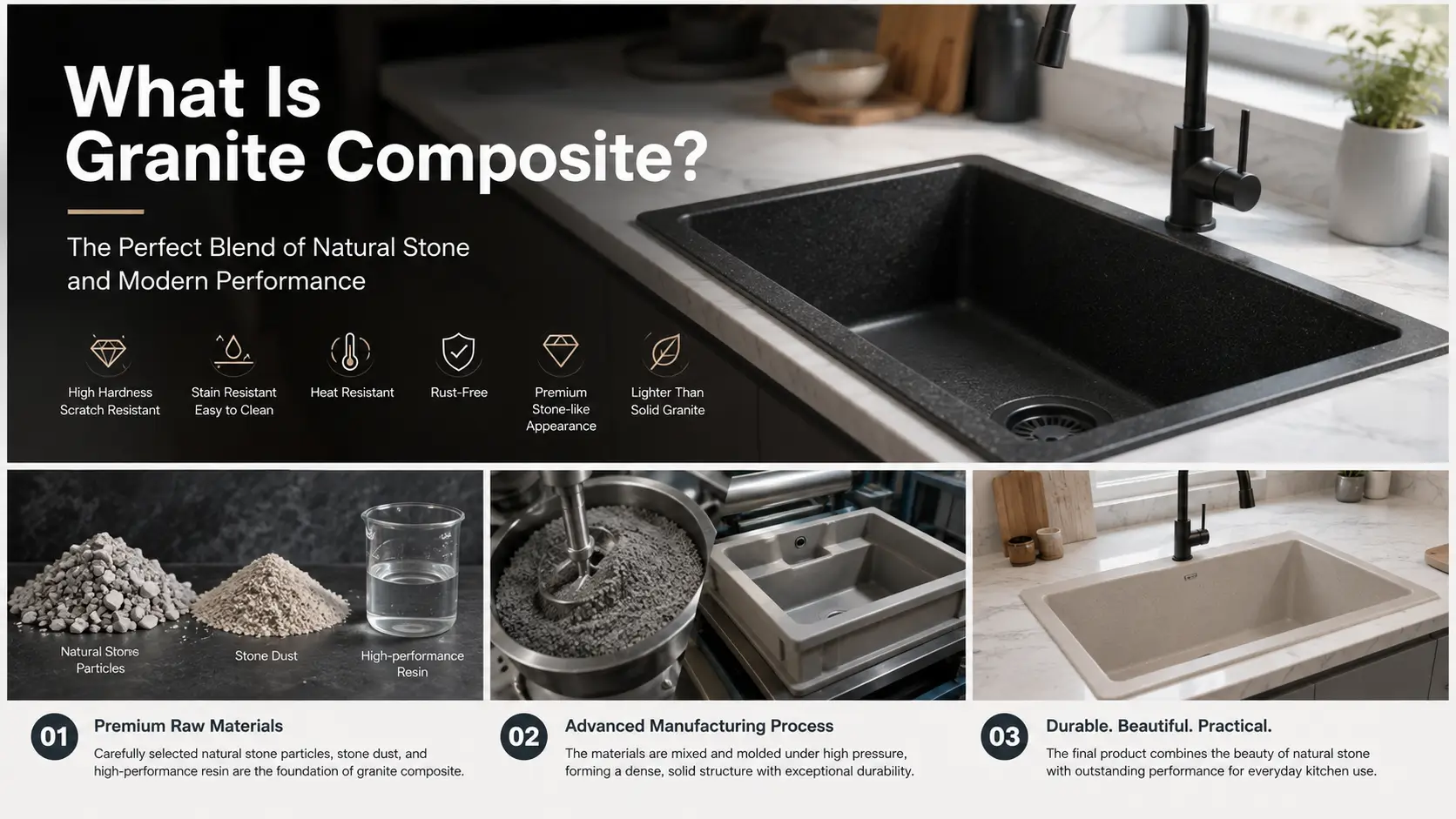
Granite composite is an engineered sink material made by combining natural stone particles, typically quartz or granite-based minerals, with a resin binder and other carefully selected components. The mixture is molded under controlled pressure to create a dense, durable material with the appearance and feel of natural stone.
Today, granite composite sinks have become a popular alternative to traditional stainless steel and ceramic sinks, offering a combination of durability, easy maintenance, and premium aesthetics.
For buyers looking for a reliable granite sink supplier, understanding how this material works is the first step toward choosing the right product.
What Is Granite Composite Made Of?
Granite composite is not simply solid granite.
Instead, it is an engineered composite material. Natural mineral particles provide hardness and the stone-like character, while resin and other components help bind the material together and allow manufacturers to form it into different sink shapes.
The exact formulation varies between manufacturers and product technologies. For example, Franke describes its Fragranite material as a quartz and acrylic resin composite, while other manufacturers use different formulations and technologies.
This engineered approach is important because it allows manufacturers to combine the desirable characteristics of natural stone with the manufacturing flexibility required for modern kitchen sinks.
Natural Stone + Modern Engineering
The basic concept can be understood simply:
Natural mineral content provides hardness and a stone-like appearance.
Resin and other components provide bonding, structural integrity and manufacturing flexibility.
Controlled molding creates the final sink shape and surface.
The result is a material that looks and feels more like stone than conventional metal sinks, while still being practical for everyday kitchen use.
SCHOCK, one of the pioneers of quartz composite sinks, describes its products as quartz composite sinks and has continued developing this material technology since 1979.
How Is a Granite Composite Sink Made?
Although manufacturing processes vary between factories, the production concept generally involves several important stages.
- Selecting the Raw Materials
The first step is selecting and preparing the mineral particles and resin system.
The quality, particle characteristics and consistency of the raw materials can influence the final appearance and performance of the sink.
- Mixing
The mineral components are carefully combined with the resin binder and other ingredients.
Uniform mixing is important because it helps achieve consistent color, density and material properties throughout the sink.
- Molding and Forming
The composite mixture is then placed into a specially designed mold.
Controlled pressure and temperature are used to form the sink into its final shape. Modern manufacturing technology allows composite sinks to be produced in a wide variety of bowl configurations, sizes, colors and installation styles.
- Finishing and Quality Control
After molding, the sink is processed and inspected.
Manufacturers may check dimensions, surface quality, color consistency and other performance characteristics before the product is packed and shipped.
For a professional granite sink supplier, consistent manufacturing and quality control are particularly important because wholesalers and distributors need products that can perform consistently across larger orders.
What Are the Advantages of Granite Composite Sinks?
The main attraction of granite composite is its balance between performance and appearance.
High Hardness and Scratch Resistance
Natural mineral content gives granite composite its characteristic hardness.
A well-manufactured composite sink is designed to withstand the normal demands of a busy kitchen, including contact with cookware, utensils and everyday food preparation.
Leading manufacturers also highlight scratch resistance as one of the key characteristics of their quartz-composite materials. Franke, for example, describes Fragranite as a durable, scratch-resistant material.
However, as with any sink material, scratch resistance does not mean that the surface is impossible to damage. Proper use and cleaning remain important.
Stain Resistance and Easy Maintenance
Kitchen sinks are exposed to food residue, sauces, coffee, tea and other substances every day.
A well-designed composite surface is relatively easy to clean and maintain. Manufacturers such as BLANCO emphasize the easy-care characteristics of their SILGRANIT material, while Franke describes its Fragranite surface as easy to clean.
For busy households, this means less time spent maintaining the sink and more time using the kitchen.
Heat Resistance
Hot cookware and boiling water are common in kitchens, so temperature resistance is another important consideration.
Granite composite materials are engineered to withstand the temperatures normally encountered during everyday kitchen activities. Specific temperature ratings, however, vary by material formulation and manufacturer, so buyers should always check the technical specifications of the individual product.
For example, Franke states that its Fragranite material is resistant to high temperatures up to 280°C, while SCHOCK lists different heat-resistance specifications for different quartz-composite materials.
A Premium Stone-Like Appearance
One of the biggest differences between granite composite and stainless steel is appearance.
Composite sinks have a natural, stone-like texture and are available in a wide range of colors, from classic black and grey to white, beige and other contemporary shades.
This makes them particularly suitable for modern kitchens where the sink is expected to complement the countertop, cabinets and overall interior design.
BLANCO and SCHOCK both offer composite sink collections in multiple colors and configurations, demonstrating the design flexibility of this material category.
Rust-Free Material
Unlike conventional steel sinks, granite composite does not develop rust in the same way metal does.
This is one reason composite sinks can be attractive in environments where buyers want a stone-like appearance without the visual characteristics of metal.
For distributors, this also creates another selling point when positioning composite sinks as a premium alternative to traditional stainless steel.
Granite Composite vs. Stainless Steel So, which material is better?
There is no single answer because each material has different characteristics.
Stainless steel is lightweight, widely used and easy to integrate into many kitchen styles.
Granite composite, on the other hand, focuses more strongly on stone-like aesthetics, color options, surface feel and a premium appearance combined with durability.
The choice ultimately depends on the target market, kitchen design, customer expectations and price positioning.
For importers and distributors, this difference can also create an opportunity to offer customers a broader product range rather than relying exclusively on stainless steel.
Is Granite Composite the Same as Solid Granite?
No.
This is an important distinction.
Solid granite is natural stone, while granite composite is an engineered material containing mineral particles combined with resin and potentially other components.
The composite manufacturing process makes it possible to produce sinks with consistent shapes, colors and dimensions while retaining a stone-inspired appearance.
It can also be more practical for sink production and handling than manufacturing a sink entirely from solid natural stone.
In other words:
Solid Granite = Natural Stone
Granite Composite = Engineered Stone-Based Material
This distinction is particularly important for buyers comparing different sink materials.
For a consumer purchasing one sink, the material is important.
For an importer, wholesaler or distributor purchasing hundreds or thousands of sinks, material consistency becomes even more important.
A professional granite sink supplier should be able to provide consistent:
Material formulation
Color and surface appearance
Sink dimensions
Wall thickness
Mold quality
Production quality
Packaging
Quality inspection
OEM/ODM capabilities
A good supplier should also be able to clearly explain the material composition, production process, available colors and technical specifications.
This is particularly important when developing a private-label or long-term distribution program.
The goal is not simply to find a factory that can produce a granite composite sink.
The goal is to find a manufacturing partner capable of delivering consistent quality from the first shipment to the next one.
Why Are Granite Composite Sinks Becoming Popular?
The popularity of composite sinks comes from a simple combination:
Performance + Appearance + Practicality
Consumers want kitchen products that can handle everyday use while fitting modern interior designs.
At the same time, distributors are looking for products that offer differentiation from standard stainless steel sinks.
Granite composite can meet both requirements.
Its stone-like appearance gives kitchens a more premium visual character, while its engineered construction provides the durability and practical maintenance characteristics expected from a modern kitchen sink.
This combination has helped establish quartz and granite composite as an important category in the international kitchen sink market. SCHOCK, for example, identifies quartz composite as a core sink material and has developed the technology for decades.
How to Choose the Right Granite Composite Sink
If you are buying a granite composite sink for your home, or sourcing products for your business, don’t look only at the price.
Consider these factors:
- Material Composition
Ask the supplier what minerals, resin and other components are used.
- Surface Quality
Check whether the surface is uniform, smooth and consistent in color.
- Performance Testing
Ask whether the supplier performs tests for scratch resistance, impact resistance, heat resistance and staining.
- Manufacturing Capability
A reliable manufacturer should have stable molds, production processes and quality-control procedures.
- Customization
For importers and distributors, check whether the supplier supports OEM, ODM, custom colors, packaging and private labeling.
- After-Sales Support
Long-term cooperation requires more than competitive pricing. Technical support, replacement policies and communication are also important.
Final Thoughts: What Is Granite Composite?
So, what is granite composite?
It is an engineered stone-based material that combines natural mineral particles with resin and other components to create a durable, practical and attractive material for kitchen sinks.
Its key advantages include:
High hardness.
Scratch resistance.
Stain resistance.
Heat resistance.
Easy maintenance.
Stone-like aesthetics.
Rust-free performance.
Most importantly, granite composite brings together the natural character of stone and the flexibility of modern manufacturing technology.
For homeowners, it can be a durable and stylish choice for a modern kitchen.
For wholesalers, importers and distributors, it can also be an attractive product category with strong design flexibility and premium positioning.
If you are looking for a reliable granite sink supplier for wholesale, OEM or private-label projects, choosing a manufacturer with consistent production capabilities and strict quality control is the key to building a successful long-term product line.
FAQ
What is granite composite?
Granite composite is an engineered material made primarily from natural mineral particles such as quartz or granite-based materials, combined with resin and other components. It is molded into a durable material commonly used for kitchen sinks.
Is granite composite better than stainless steel?
Neither material is universally better. Stainless steel is lightweight and versatile, while granite composite offers a more stone-like appearance, multiple color options and a premium surface feel. The best choice depends on the application and target market.
Are granite composite sinks scratch resistant?
Granite composite sinks are generally designed to provide good scratch resistance. However, no sink surface is completely scratch-proof, so proper use and care are still recommended.
Are granite composite sinks heat resistant?
Yes, granite composite materials are designed to withstand normal kitchen temperatures. However, heat-resistance specifications vary by manufacturer and formulation, so buyers should check the technical data for the specific sink.
Do granite composite sinks rust?
Granite composite is not a metal material, so it does not rust like traditional steel.
Are granite composite sinks easy to clean?
Yes. Their engineered surfaces are generally designed for easy everyday cleaning. Regular cleaning with appropriate products can help maintain the appearance of the sink.
What should I look for in a granite sink supplier?
Look for consistent material quality, stable manufacturing processes, quality-control procedures, reliable packaging, customization capabilities and experience with international B2B orders.
